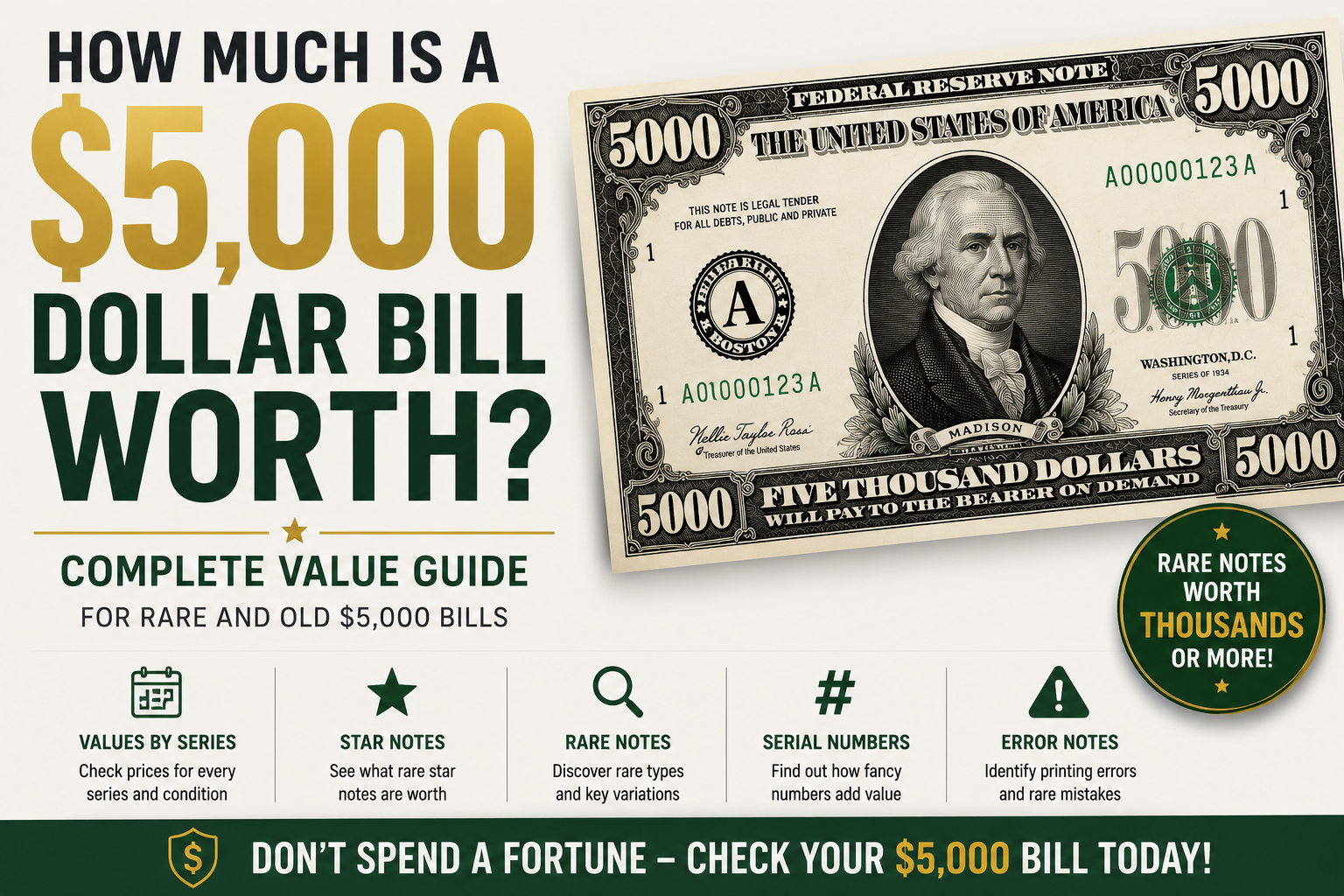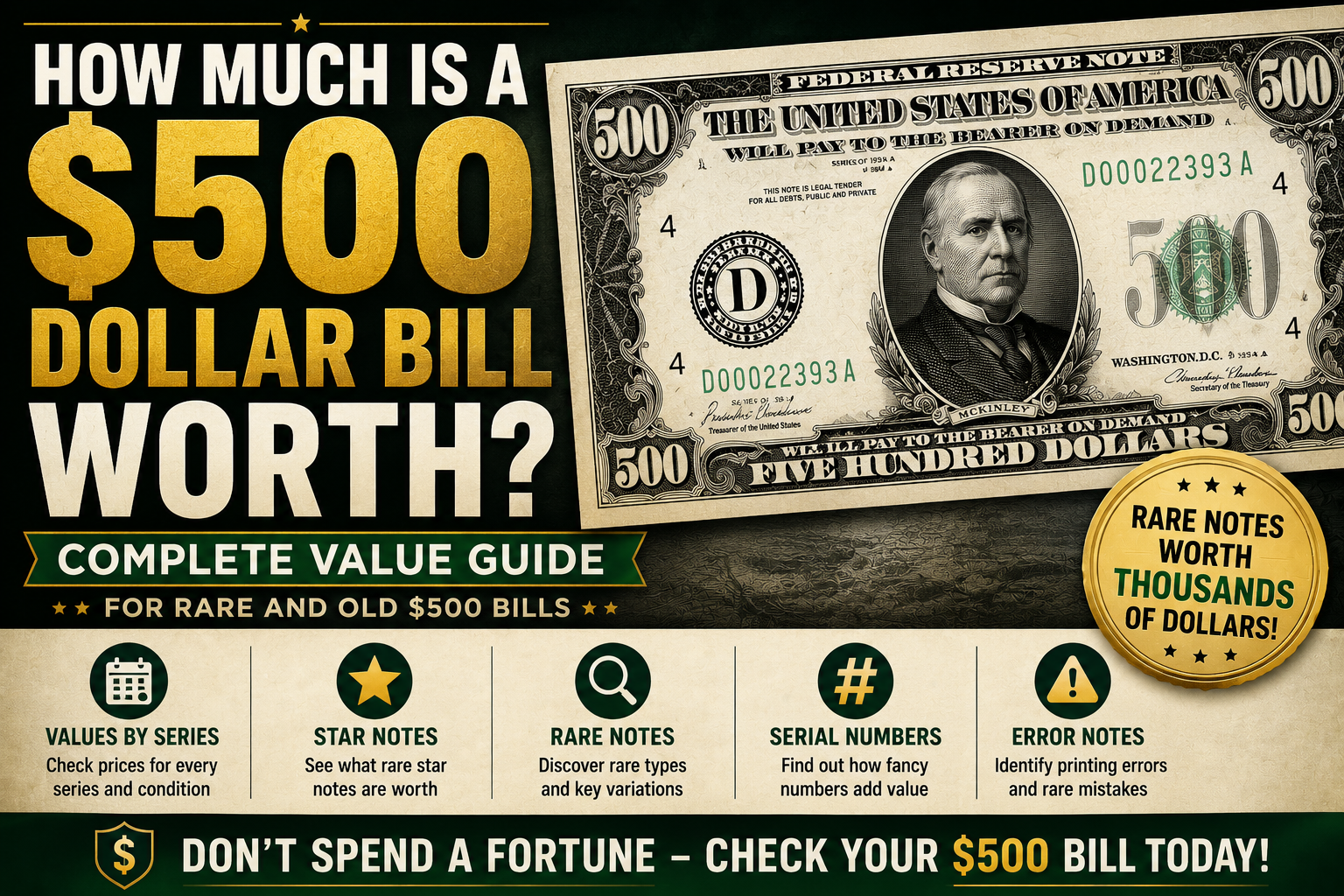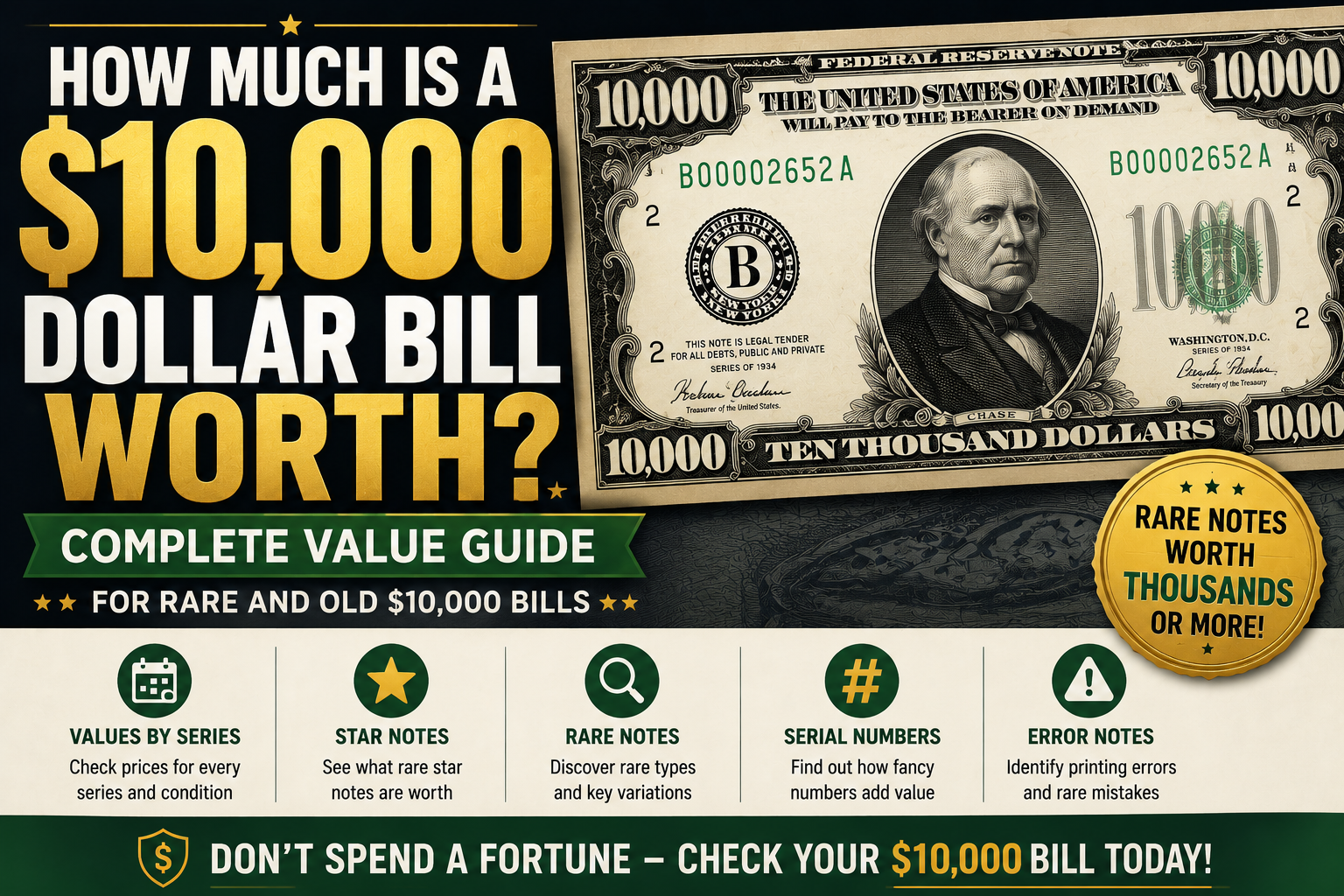
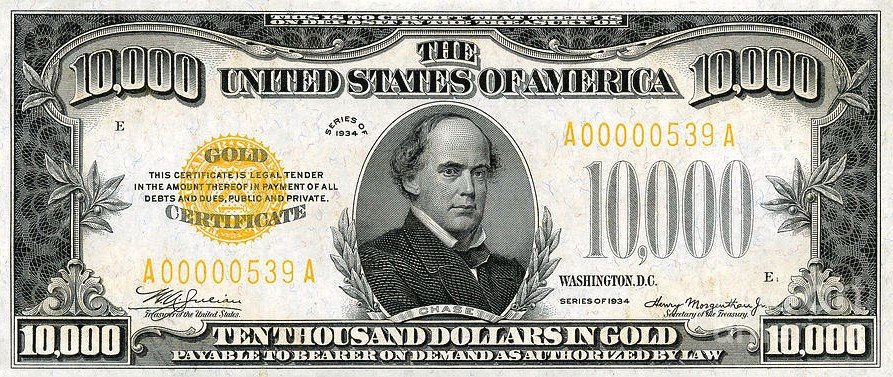
The $10,000 bill is one of the rarest and most valuable pieces of United States currency ever issued. Featuring the portrait of Salmon P. Chase, former Secretary of the Treasury and Chief Justice of the United States, these notes are highly sought after by collectors.
If you’re wondering “How much is a 10,000 dollar bill worth?”, the answer depends on the series, condition, rarity, and serial number.
Although the face value is $10,000, most surviving examples sell for much more.
$10,000 Bill Value Chart
| Series | Type | Seal | Circulated Value | Uncirculated Value |
|---|---|---|---|---|
| 1918 | Federal Reserve Note | Blue | $30,000–$75,000 | $150,000+ |
| 1928 | Federal Reserve Note | Green | $25,000–$80,000 | $175,000+ |
| 1934 | Federal Reserve Note | Green | $20,000–$60,000 | $125,000+ |
| 1934A | Federal Reserve Note | Green | $25,000–$75,000 | $150,000+ |
Modern Market Value of a $10,000 Bill
Because these notes are no longer printed and very few survive in private hands, collectors often pay substantial premiums.
| Condition | Estimated Value |
|---|---|
| Heavily Circulated | $20,000–$35,000 |
| Average Circulated | $35,000–$60,000 |
| Extremely Fine | $60,000–$100,000 |
| Uncirculated | $125,000–$250,000+ |
Who Is on the $10,000 Bill?
The $10,000 bill features:
Salmon P. Chase
- Secretary of the Treasury under Abraham Lincoln
- Chief Justice of the United States
- Instrumental in establishing the modern U.S. banking system
His portrait appears on all small-size $10,000 Federal Reserve Notes.
Why Is the $10,000 Bill So Valuable?
Extremely Limited Supply
Very few $10,000 bills remain in private collections today.
Most were returned to banks and destroyed after the government discontinued large-denomination currency.
Historical Significance
These notes were primarily used for:
- Interbank transfers
- Federal Reserve transactions
- Large financial settlements
They were never commonly used by the general public.
Strong Collector Demand
Because of their rarity and prestige, demand remains strong among elite currency collectors.
Are $10,000 Bills Still Legal Tender?
Yes.
Although production ended decades ago, genuine $10,000 bills remain legal tender in the United States.
However, spending one would make little sense because collectors typically pay many times the face value.
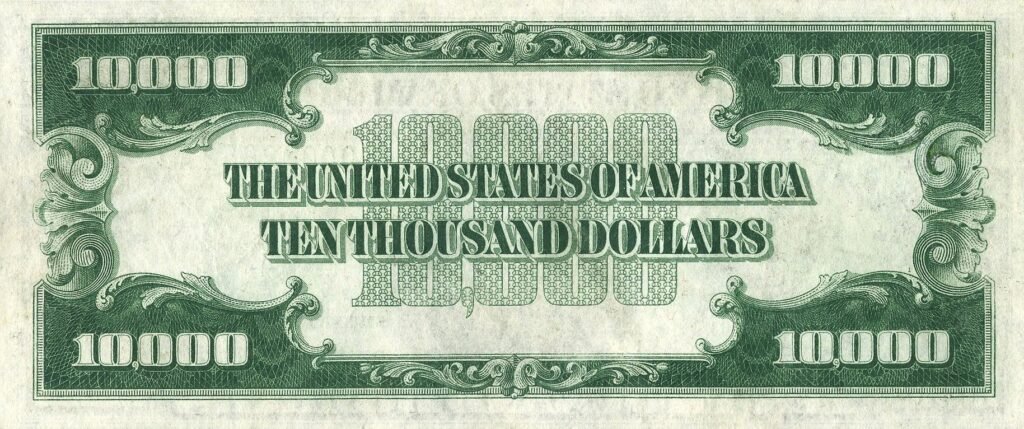
Star Note $10,000 Bill Value
Star Notes are among the rarest examples of large-denomination currency.
A Star Note contains a star symbol (★) in the serial number.
Values can be extraordinary:
| Type | Estimated Value |
|---|---|
| Circulated Star Note | $50,000–$200,000+ |
| Uncirculated Star Note | $200,000–$500,000+ |
Valuable Serial Numbers
Collectors pay premiums for:
- 00000001
- Low serial numbers
- Solid serial numbers
- Radar serial numbers
- Repeater serial numbers
On a $10,000 bill, a rare serial number can add tens of thousands of dollars in value.
Rare $10,000 Bill Types Worth Checking
| Feature | Potential Value |
|---|---|
| Star Note | $50,000–$500,000+ |
| Low Serial Number | $25,000–$250,000+ |
| Radar Serial Number | $25,000–$100,000+ |
| Repeater Serial Number | $25,000–$100,000+ |
| Solid Serial Number | $100,000–$1,000,000+ |
| Printing Error | $50,000–$500,000+ |
| Uncirculated Condition | Major premium |
Frequently Asked Questions
Is a $10,000 bill real?
Yes. The United States issued genuine $10,000 bills for many years.
How many $10,000 bills still exist?
Only a limited number survive today, making them extremely collectible.
Can I spend a $10,000 bill?
Yes, it remains legal tender, although selling it to a collector is usually far more profitable.
What is the rarest $10,000 bill?
High-grade examples, Star Notes, and low serial number notes are among the rarest.
What is the highest denomination U.S. bill ever printed?
The United States printed notes as high as $100,000, though those were never released for public circulation.
Final Thoughts
If you’re asking how much is a 10,000 dollar bill worth, the answer is typically far more than its face value.
Most surviving examples trade between $20,000 and $250,000+, while rare Star Notes, low serial numbers, and pristine uncirculated notes can reach even higher prices.
The $10,000 bill remains one of the most fascinating and prestigious pieces of American paper money ever issued.